
Is my refrigerator filter enough for Houston drinking water?
Refrigerator filters are convenient. They’re built in, easy to replace, and marketed as a complete drinking water solution. So it’s reasonable for Houston homeowners to ask:
Is my refrigerator filter actually enough for my drinking water?
In most Houston homes, the honest answer is a big NO. The reason has more to do with what’s dissolved in the water than what you can see or taste right away.
What refrigerator filters are designed to do:
Most refrigerator filters are small activated carbon filters. Their primary job is to improve basic taste and odor by reducing some chlorine and catching larger particles.
They can help with:
Mild chlorine taste
Sediment larger than a few microns
Short-term odor improvement
They are designed for convenience, not comprehensive treatment.
They are also usually forgotten, so you aren’t just getting a low level filtrations… you are also getting negative effects from a filter that hasn’t been changed properly or regularly.
What refrigerator filters are not designed to remove:
Houston drinking water contains contaminants that refrigerator filters are not built to handle, including:
Chloramines (Houston’s primary disinfectant)
Total dissolved solids (TDS)
Fluoride
Nitrates
PFAS and other emerging contaminants
Dissolved metals at meaningful levels
Because these substances are fully dissolved in the water, they pass straight through most refrigerator filters.
This is why many homeowners say:
“The water still tastes off.”
“The ice tastes worse than the water.”
“Replacing the filter didn’t really fix it.”
Why ice and cold water make the problem more noticeable:
Ice concentrates whatever is in the water. As water freezes, impurities become more noticeable, which is why bad-tasting ice is one of the most common complaints—even in homes with new refrigerator filters.
If your ice tastes chemical, bitter, or stale, the issue is almost always upstream of the refrigerator.
The chloramine problem in Houston:
Houston uses chloramines, a combination of chlorine and ammonia, because they last longer in the distribution system. While effective for safety, chloramines are:
Harder to remove than chlorine
More noticeable in taste and odor
Resistant to small carbon filters
Most refrigerator filters are not rated to reduce chloramines at meaningful levels.
Why replacing the fridge filter often doesn’t solve it:
Even when replaced on schedule, refrigerator filters:
Have limited contact time
Handle very small volumes of carbon
Become saturated quickly
Once saturated, they may stop improving taste entirely or release trapped compounds back into the water.
This is why some homeowners notice little to no improvement after replacement.
How reverse osmosis solves what refrigerator filters can’t:
Reverse osmosis treats drinking water before it ever reaches your refrigerator. Instead of masking taste, it removes contaminants at the molecular level.
R.O. systems reduce:
Chloramines
Dissolved solids
Fluoride
Nitrates
PFAS
Metals that affect taste
When R.O. water feeds the refrigerator:
Ice becomes clear and neutral-tasting
Cold water tastes clean and consistent
Coffee and tea improve noticeably
This is why many Houston homeowners pair R.O. with their refrigerator instead of relying on the built-in filter.
Why this matters more in Houston than other cities
Houston’s water chemistry includes:
Chloramine disinfection
Moderate to high dissolved solids
Seasonal variability
These conditions make endpoint filters far less effective than whole-system or point-of-use purification.
Why Environmental ProTech
At Environmental ProTech, we help homeowners understand what their refrigerator filter can and cannot do.
Our free water test measures:
Chloramine levels
Total dissolved solids
Overall drinking water quality
From there, we help you decide whether reverse osmosis makes sense for your home, lifestyle, and health goals.
We’ve been treating Houston water for over 30 years, and refrigerator filter frustration is one of the most common reasons homeowners call us.
What customers are saying…
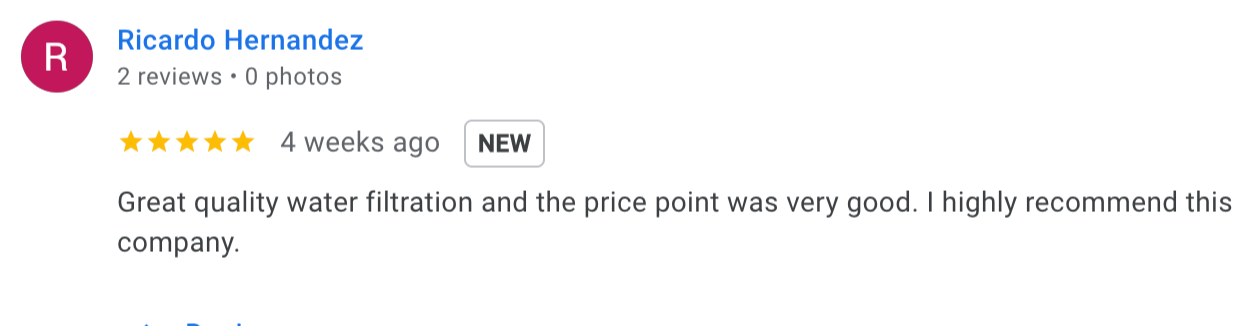
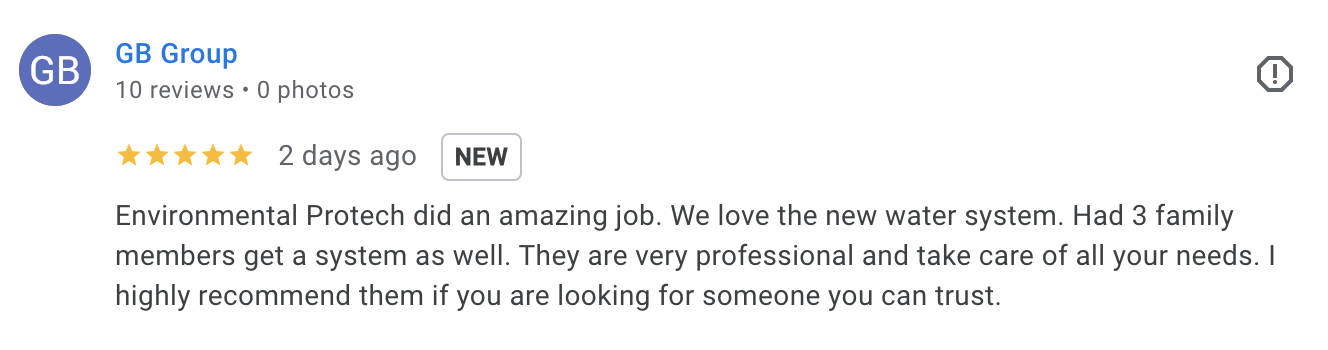

PS. We have over 30 years experience in bringing clean water to the Houston Homeowners. Our reviews speak for themselves! If you want clean drinking water from your faucet, contact us at 281-495-4420 to schedule your free water test today.
Sources
U.S. Environmental Protection Agency – Chloramines in Drinking Water
https://www.epa.gov/dwreginfo/chloramines-drinking-waterWater Quality Association – Reverse Osmosis and Drinking Water
https://www.wqa.orgU.S. Geological Survey – Dissolved Solids in Water
https://www.usgs.gov/special-topics/water-science-school/science/total-dissolved-solidsCenters for Disease Control and Prevention – Household Water Treatment
https://www.cdc.gov/healthywater/drinking