
What is the Difference Between Faucet-Mount / Pitchers and Reverse Osmosis?
Many Houston homeowners start with a pitcher filter or faucet-mount filter when trying to improve their drinking water. They’re temporarily convenient, inexpensive, and easy to find in stores.
But if you’ve ever wondered why your water still doesn’t taste great or why certain contaminants remain, it’s because: pitcher and faucet filters are not designed to do what reverse osmosis does.
Here’s a clear breakdown of the differences, what each system removes, and when you need more than basic filtration.
What Faucet-Mount and Pitcher Filters Actually Do
Pitchers (like Brita or PUR) and faucet-mount filters use activated carbon, which is good at removing:
Chlorine
Some tastes and odors
Some volatile organic compounds (VOCs)
A small subset of chemicals
These filters are helpful for basic improvement, especially if your only concern is taste or chlorine.
However, they do not remove:
Dissolved solids
Heavy metals like arsenic or chromium
Nitrates
Sodium
Fluoride
PFAS (“forever chemicals”)
Microplastics
Most bacteria or viruses
Hardness minerals
Salts
They are “aesthetic filters,” meaning they improve taste and smell, but not purity.
They can be a good starter option, especially if you are in an apartment or rented home where you cannot make significant improvements to the space.
What Reverse Osmosis Does (and Why It’s Different)
Reverse osmosis is a completely different technology. It purifies water at the molecular level, removing contaminants that carbon filters cannot touch.
An R.O. system removes:
Dissolved minerals
Metals (lead, arsenic, chromium, copper)
Nitrates/nitrites
PFAS
Fluoride
Salts
Chemical compounds and pesticides
Microplastics
Many bacteria and viruses (with UV or pre-treatment)
This is why R.O. water tastes noticeably cleaner. It’s not just filtered, it’s purified.
Side-by-Side Comparison
I asked chatgpt to do a side-by-side comparison and this is what it sent me:
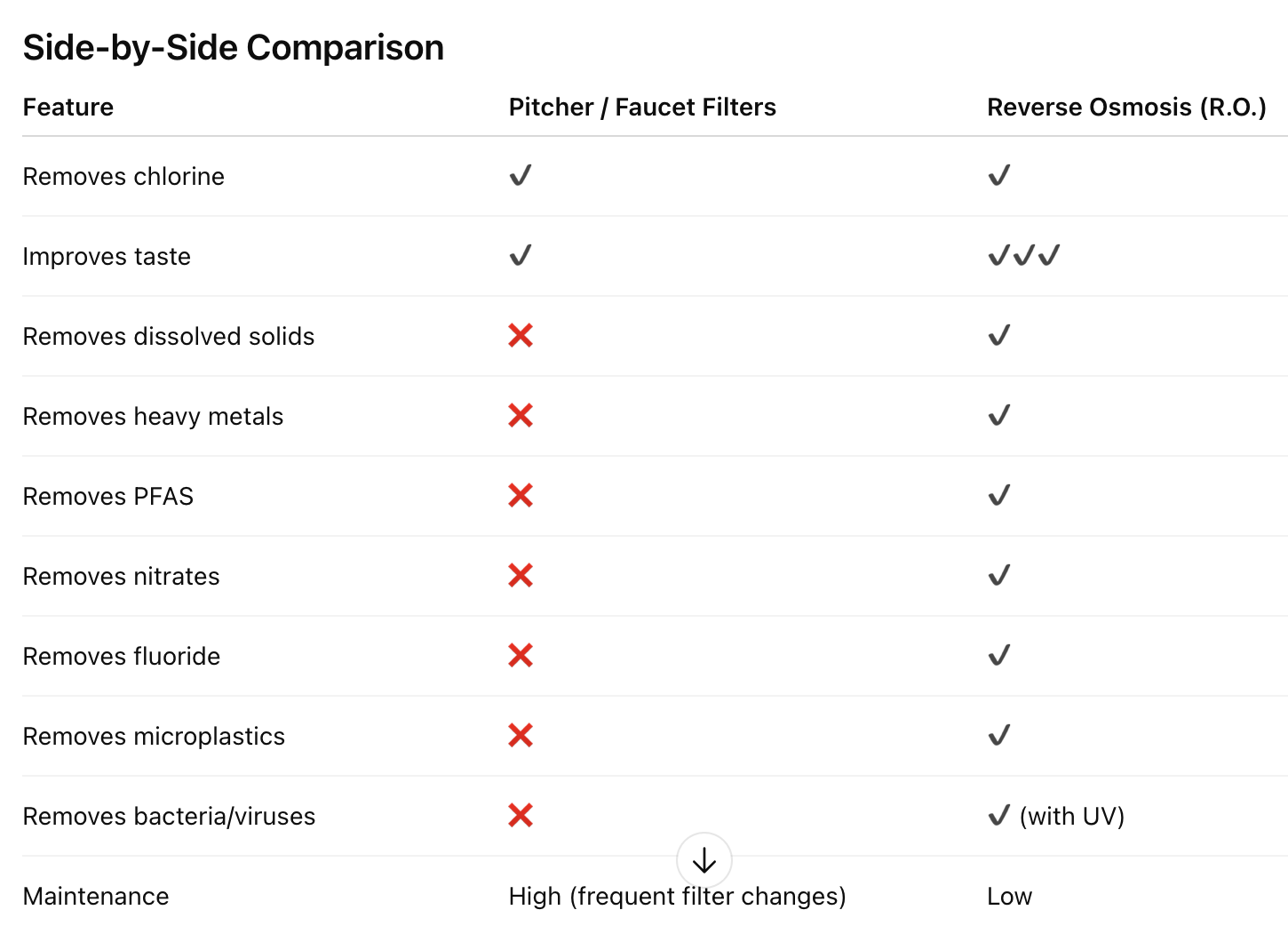
Not only is an RO superior in providing clean water, it’s also less expensive long-term.
When a Pitcher or Faucet Filter Is Enough
These smaller filters work fine if your goal is simply to:
Improve taste
Reduce chlorine
Make city water more palatable
For many apartments or temporary living arrangements, they’re an easy upgrade.
When You Need Reverse Osmosis
If your home deals with:
Well water
PFAS concerns
Arsenic or heavy metals
Nitrates
Salty or metallic taste
High total dissolved solids (TDS)
Water for newborns or immune-sensitive individuals
Cooking and coffee flavor issues
In these cases, a pitcher or faucet filter will not solve the problem.
Reverse osmosis is the standard for true drinking-water safety and taste.
Why Houston Homes Benefit Most From Reverse Osmosis
Houston’s water commonly contains:
High chlorine/chloramine
Dissolved solids
Metals from older plumbing
PFAS (detected across Texas)
Hardness minerals affecting taste and cooking
Pitcher filters can’t remove these.
R.O. systems can.
Even homes with whole-home softeners and carbon filters rely on R.O. for drinking water.
Why Environmental ProTech
At Environmental ProTech, we’ve installed R.O. systems in Houston homes for more than 30 years. We size and design each system based on:
Your water test
Your plumbing layout
Your water usage
Your pressure and flow requirements
Our goal is simple: deliver the cleanest, safest drinking water possible right from your kitchen tap.
Find out if an RO is right for you!
PS. We have over 30 years experience in bringing clean water to the Houston Homeowners. Our reviews speak for themselves! If you want clean drinking water from your faucet, contact us at 281-495-4420 to schedule your free water test today.
Sources & Further Reading
Centers for Disease Control and Prevention – Home Water Treatment
https://www.cdc.gov/healthywater/drinking/home-water-treatmentWater Quality Association – Reverse Osmosis Overview
https://www.wqa.orgTexas Commission on Environmental Quality – Drinking Water Quality
https://www.tceq.texas.gov/drinkingwater/quality.html